OceanBase Vector Database Boosts AI Retrieval Efficiency by 45x and Halves AI Agent Development Costs
In the era of AI LLMs, vector databases have become core infrastructure for AI applications. With the popularization of RAG (Retrieval-Augmented Generation) technology, more and more enterprises need to store and retrieve vector data in their databases.
OceanBase 4.3 fully supports vector database capabilities, providing powerful underlying support for AI applications.
Why Do We Need a Vector Database?
In traditional relational databases, we mainly retrieve data through exact matching or fuzzy matching. But in AI scenarios, we often need to perform operations such as semantic search and similarity matching, which require the support of a vector database.
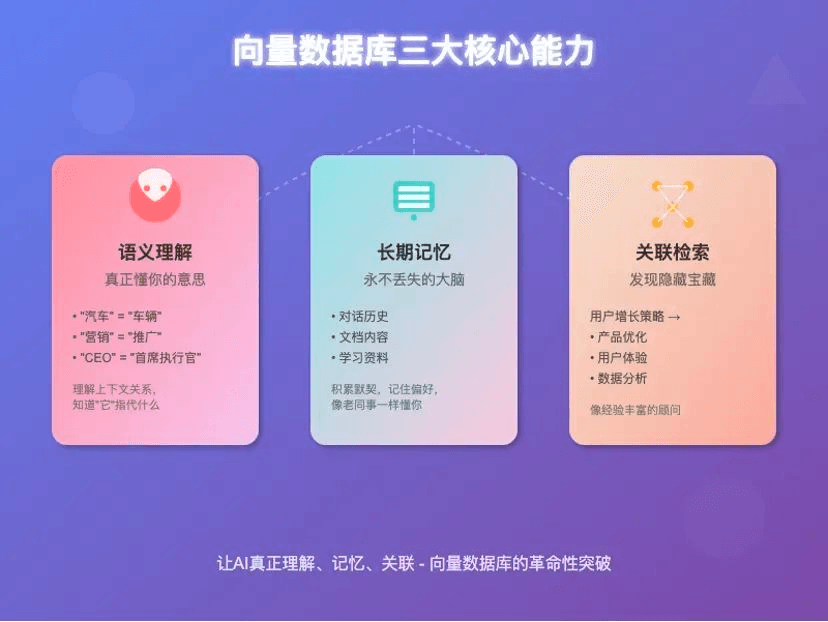
The core capabilities of a vector database include:
- Vector storage — Storing high-dimensional vector data
- Vector indexing — Building efficient vector indexes (such as HNSW, IVF, etc.)
- Vector search — Supporting ANN (Approximate Nearest Neighbor) search
- Hybrid search — Combining vector search with traditional search (full-text search, conditional filtering, etc.)
Core Capabilities of the OceanBase Vector Database
1. HNSW Vector Index
OceanBase 4.3 supports the HNSW (Hierarchical Navigable Small World) vector index, an efficient approximate nearest-neighbor search algorithm.
Characteristics of the HNSW index:
- Hierarchical structure — Accelerates search through a multi-layer graph structure
- High recall — With reasonable parameter settings, recall can exceed 95%
- Low latency — Maintains millisecond-level retrieval latency even at large scale
2. Multimodal Vector Support
OceanBase supports multiple vector types:
- Dense vectors — Supports float-type dense vectors
- Sparse vectors — Supports the storage and retrieval of sparse vectors
- Multimodal vectors — Supports multimodal vectors for text, images, audio, and more
3. Hybrid Search Capability
OceanBase’s hybrid search capability is one of its core advantages:
- Vector + full-text search — Supports fused queries combining vector search and full-text search
- Vector + conditional filtering — Supports conditional filtering on top of vector search
- Multi-path recall — Supports combining multiple retrieval strategies

4. Distributed Architecture
OceanBase’s distributed architecture brings the following advantages to the vector database:
- Horizontal scaling — Supports distributed deployment for flexible scaling
- High availability — Ensures data consistency through the Paxos protocol
- Multi-tenancy — Supports multi-tenant isolation, well suited for SaaS scenarios
Performance
According to official test data, the OceanBase vector database delivers excellent performance:
- Index-build performance — Supports fast index building for large-scale data
- Retrieval performance — Keeps P99 latency at the millisecond level under high concurrency
- Recall — Achieves over 95% recall with reasonable parameter settings
- Storage efficiency — Lower storage cost compared with dedicated vector databases
Typical Application Scenarios
1. RAG Applications
In RAG (Retrieval-Augmented Generation) scenarios, the OceanBase vector database can serve as the underlying storage for a knowledge base:
- Vectorize documents and knowledge bases and store them in OceanBase
- When a user asks a question, use vector search to find the most relevant document fragments
- Pass the retrieval results to the LLM to generate an accurate answer
2. Semantic Search
In scenarios such as e-commerce and content platforms, semantic search can be implemented through vector search:
- Vectorize the descriptive information of products and content
- When a user searches, use semantic matching to find the most relevant results
- Combine with traditional retrieval conditions (price, category, etc.) for filtering
3. Recommendation Systems
In recommendation systems, similar-item recommendation can be implemented through vector search:
- Vectorize the features of users and items
- Use vector search to find the most similar users or items
- Combine with business rules to generate recommendations
AI Retrieval Efficiency Soars by 45x
According to real-world test data, after adopting the OceanBase vector database:
- 45x improvement in retrieval efficiency — Compared with traditional exact matching, vector search efficiency increases dramatically
- 50% reduction in development costs — An integrated database solution that requires no additional vector database to maintain
- Lower operational complexity — A unified database platform that reduces operational costs
Outlook
As AI technology continues to evolve, vector databases will keep advancing in the following directions:
- More efficient indexing algorithms — Supporting more index types, such as IVF, PQ, etc.
- Smarter retrieval strategies — Combining AI technology to achieve adaptive retrieval
- Better ecosystem integration — Deep integration with mainstream AI frameworks and toolchains
- Multimodal fusion — Supporting vector search across more modalities
The OceanBase vector database provides powerful underlying support for AI applications, boosting AI retrieval efficiency by 45x and halving development costs. Going forward, OceanBase will continue to deepen its work in the vector database field and provide even better support for AI applications.
To learn more about OceanBase vector database technology, visit: https://open.oceanbase.com