OceanBase Community Monthly: AgentSeek Launches as seekdb Delivers a 22× Streaming Throughput Gain
This June 2026 OceanBase community roundup covers seekdb 1.3.0, the first release of the AgentSeek agent-engineering toolkit, updates to obd and obdiag, a new ecosystem compatibility certification, and community events.
Key updates include:
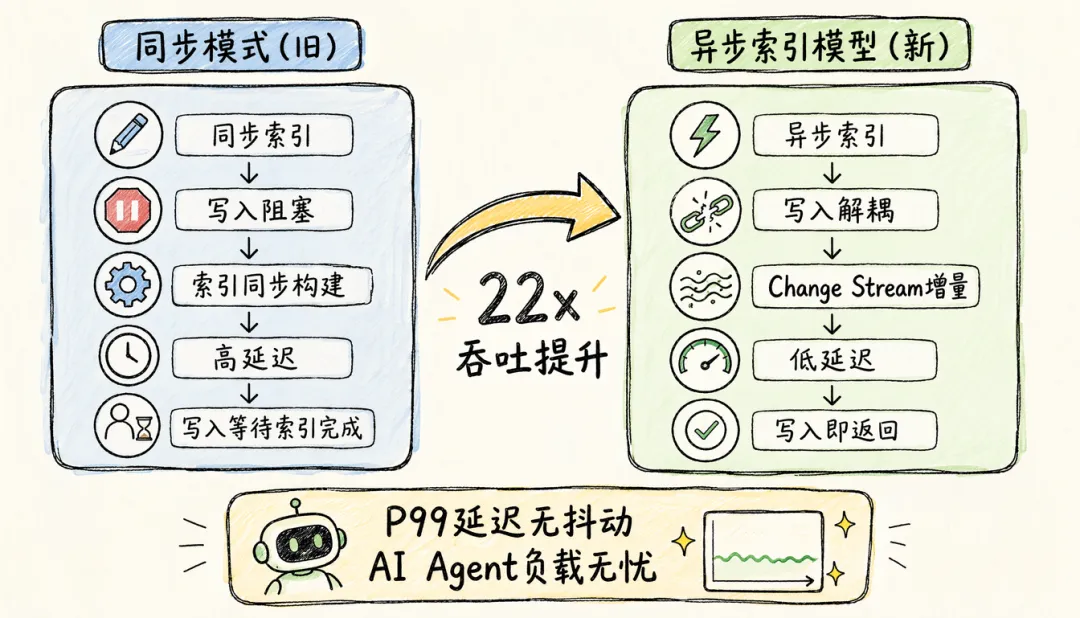
- seekdb 1.3.0 introduces an asynchronous indexing model based on Change Stream and reports approximately 22× higher throughput than synchronous indexing in streaming-write scenarios.
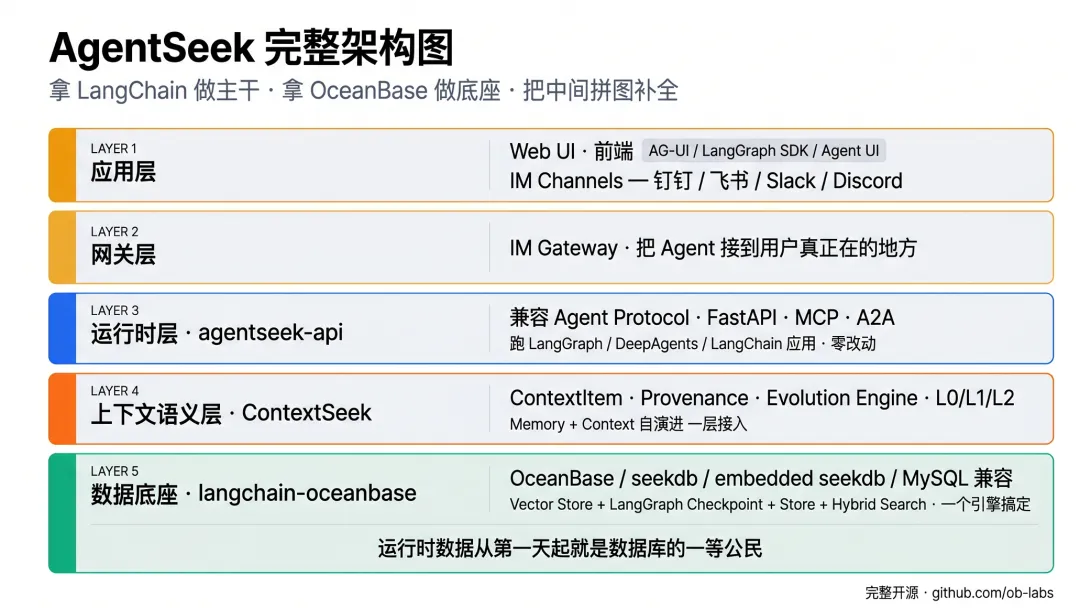
- AgentSeek, built with OceanBase and LangChain, brings together an agent data foundation, context layer, runtime, gateway, and application layer.
- obd 4.4.0 adds visual seekdb deployment, while obdiag 5.0.0 adopts a LangChain/LangGraph-based deepagents TUI for richer diagnostic-agent interactions.
- One product, Guopin Online School Digital Intelligence Training Platform V2.0, received OceanBase V4 compatibility certification in May.
🚀 Curious about the database behind this month’s Agent news? seekdb is OceanBase’s open-source AI-native database—come try it at https://github.com/oceanbase/seekdb and see how it handles vectors, streaming writes, and Agent workloads.
seekdb 1.3.0: asynchronous indexing for AI agent workloads
OceanBase seekdb 1.3.0 is a major release focused on multi-platform support and performance. Its asynchronous indexing model is designed for workloads that ingest data continuously while serving retrieval requests.
The release uses the Change Stream incremental framework to decouple writes from index construction. Indexes are built asynchronously, rather than requiring each write to wait for a synchronous index update. In streaming scenarios, seekdb reports approximately 22× higher write throughput than synchronous indexing, while maintaining stable retrieval performance.
The release also adds vector-column support to Diff & Merge. Fork Table and Fork Database now work with asynchronous indexes, further improving multi-version data management.
AgentSeek: an agent-engineering toolkit built on OceanBase and LangChain
OceanBase AgentSeek is an agent-engineering toolkit built on OceanBase and LangChain. Its first release provides tools and libraries for building agents with a data feedback loop. The architecture combines open-source components rather than requiring every layer to be developed in-house:
- Data foundation: OceanBase provides support from edge-side seekdb to the cloud and is compatible with the MySQL protocol.
- Context semantic layer: manages memory, RAG content, and tool-call results, with retrieval, self-evolution, and evidence-traceability capabilities.
- Runtime layer: turns local applications into services and supports deployment with Docker and Kubernetes. It has initial integrations with Agent Protocol, MCP, and A2A for LangChain ecosystem applications.
- Gateway layer: connects agents to DingTalk, Lark, Slack, and Discord. It also supports agent front ends based on protocols such as AG-UI, including human-in-the-loop workflows and streaming output.
- Application layer: hosts concrete agent applications built on the runtime and standard protocols.
The related projects—AgentSeek, AgentSeek-api, ContextSeek, langchain-oceanbase, and OceanBase seekdb—are open source and welcome issues, pull requests, and contributions.
Tooling updates: obd 4.4.0 and obdiag 5.0.0
obd 4.4.0 adds the following deployment and administration capabilities:
- Visual deployment of seekdb.
- Deployment of obagent, Prometheus, and ob-dashboard monitoring components for seekdb.
- HTTPS support for obshell.
- The
obd cluster tenant set-sync-modecommand for configuring primary-standby tenant synchronization modes: maximum performance, maximum availability, or maximum protection. - The
--sync-mode,--net-timeout, and--health-check-timeoptions for setting synchronization mode, network timeout, and health-check settings at creation time. - Switchover (planned switch) and failover (failure switch) plugins for changing primary-standby tenant roles.
Starting with obdiag 5.0.0, the diagnostic agent is built on the LangChain/LangGraph-based deepagents TUI. It provides richer interactions through a Textual terminal UI, skill management, and subagents. Users can describe diagnostic requirements in natural language, and obdiag can invoke its collection, analysis, inspection, and root-cause-analysis capabilities.
Ecosystem compatibility certification
In May, one additional product received OceanBase compatibility certification:
| Partner | Product | Product version | OceanBase version | Certificate number |
|---|---|---|---|---|
| Guotou Human Resources Service Co., Ltd. | Guopin Online School Digital Intelligence Training Platform | V2.0 | V4 | OB2026050001B |
Community activity
On May 30, OceanBase and the LangChain Community jointly hosted the “Building Reliable, Cost-Efficient Enterprise Agent Infrastructure” technical meetup at the Shanghai Zhangjiang Science Gate. Database, large-language-model, and agent-development practitioners discussed agent-native data foundations, AgentSeek adoption, industry cases, and hands-on demonstrations.
The community will also host June online sessions on context evolution, agent development, AI infrastructure, and AgentOps.