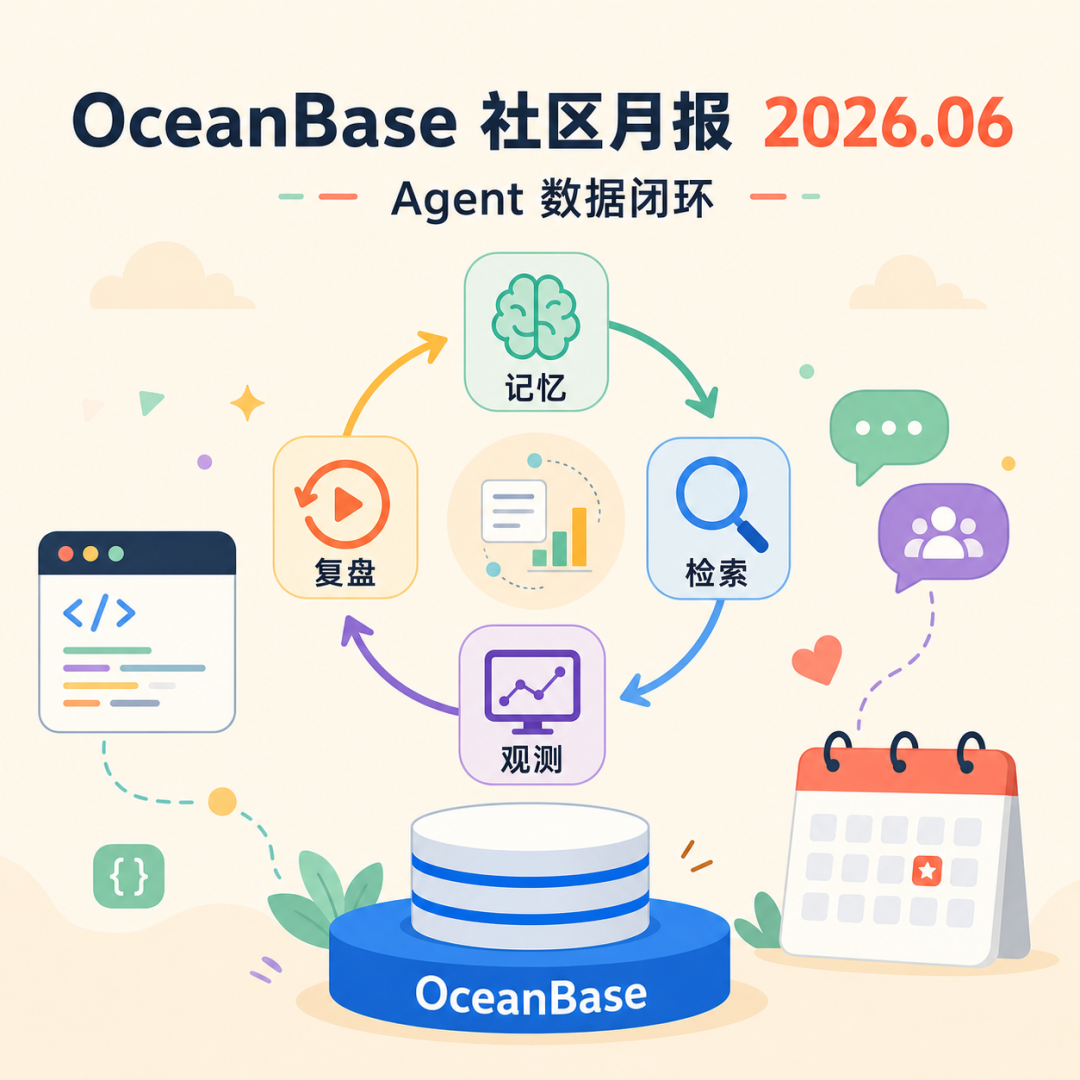
OceanBase Community Monthly: Building Agents with a Closed Data Loop
The July 2026 edition of OceanBase Community Monthly covers PowerMem 1.1.x and AgentSeek 0.0.2–0.0.4, which help developers build agents with a closed data loop. It also highlights three new ecosystem certifications, June community events, the Easy Data x AI course call for contributors, and July meetups.
AI Product Updates
PowerMem 1.1.x
PowerMem 1.1.x keeps upgrading long-term memory, IDE integration, and session observability so coding agents no longer “forget.”
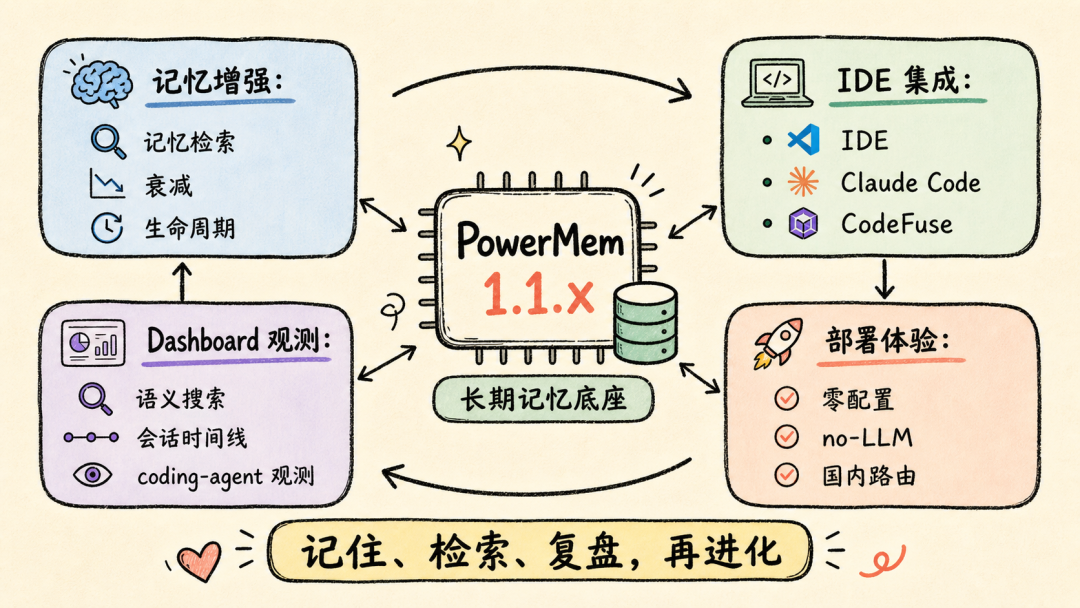
PowerMem shipped seven releases from v1.1.1 through v1.1.7, focused on IDE/Claude Code integration, Dashboard search and observability, zero-config and no-LLM deployment, Chinese documentation, MCP/plugin publishing, and more stable memory retrieval and lifecycle management.
- v1.1.1: Added IDE integration and MoonBit HTTP API examples, strengthened Dashboard regression tests, and fixed SQLite filter injection, OpenAI LLM issues, and empty user-profile fields.
- v1.1.2: Improved configuration and deployment: custom memory-processing environment variables, a built-in default embedding for zero-config startup, optional CLI/server/MCP/seekdb extras, plus multi-client integration guides and a Claude Code install flow.
- v1.1.3: Dashboard gained semantic search with time-range and sort support; added CodeFuse IDE support; improved memory-sharing permissions, forgotten-memory ranking, and the MCP publish flow.
- v1.1.4: Retrieval API now accepts filter conditions; memory lists can filter by scope; the service can open the Dashboard on startup; the default data directory moved to
~/.powermem; memory decay and graph isolation were improved. - v1.1.5: Added no-LLM mode and
NoopEmbedding; embedding-model downloads are bundled with PowerMem and support China-region routing; added Claude Code Hook privacy controls, coding-agent observability, and a session-timeline API; started shipping plugins and multi-platform binaries. - v1.1.6: Completed Chinese docs and site localization; init now supports interactive Q&A and remote-init; SQLite defaults target coding agents; published standalone binary assets; improved MCP ID precision, memory retention fields, and fresh-memory retrieval.
- v1.1.7: Plugins enable transcript inference by default; recall/remember skills were slimmed down; fixed
powermem-mcphelp behavior.
The project is open source at https://github.com/oceanbase/powermem. Try it out, open an issue, or contribute a PR.
AgentSeek Releases v0.0.2–v0.0.4
OceanBase AgentSeek is an agent-engineering toolkit built on OceanBase and LangChain. It provides tools and libraries that help developers quickly build an agent flywheel with closed-loop data capabilities.
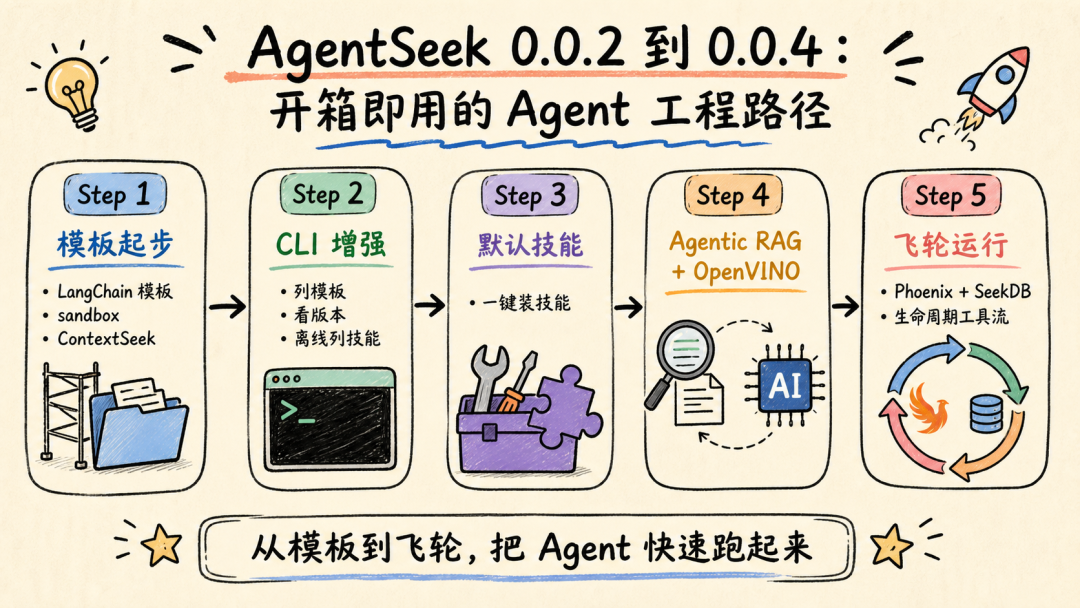
AgentSeek v0.0.2–v0.0.4 continue to accelerate agent application development—from LangChain and Agentic RAG templates and OpenVINO support to one-click skill installation and lifecycle workflows—making it easier to get a working agent up and running out of the box.
v0.0.2: Improved the LangChain developer experience with a developer guide and multiple templates, including sandbox, ContextSeek/Bub, and a deepagents content builder.v0.0.3: Enhanced the CLI with commands to show the version, list templates, list skills offline, and add skills by default, along with a unified project entry point.v0.0.4: Added Agentic RAG and OpenVINO templates, integrated Phoenix and SeekDB into the default LangChain template, and improved the lifecycle workflow.
All AgentSeek-related projects are open source. Try them, open issues, or contribute PRs:
- AgentSeek: https://github.com/ob-labs/agentseek
- AgentSeek-api: https://github.com/ob-labs/agentseek-api
- ContextSeek: https://github.com/ob-labs/contextseek
- langchain-oceanbase: https://github.com/oceanbase/langchain-oceanbase
Ecosystem Product Certification Progress: Three New Compatible Products
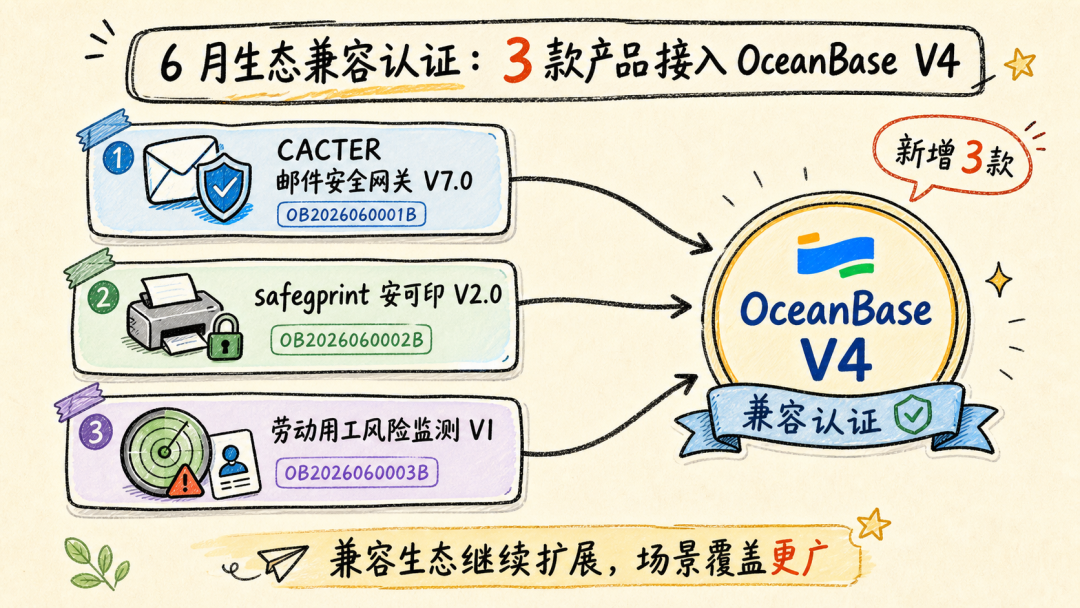
Three ecosystem compatibility certifications were added in June.
Details:
| Partner | Product | Product version | OB version | Certificate ID |
|---|---|---|---|---|
| Guangdong Yingshi Computer Technology Co., Ltd. | CACTER Email Security Gateway System | V7.0 | V4 | OB2026060001B |
| Shenzhen Yide Information Technology Co., Ltd. | safegprint Ankeyin Print Information Security Control System (V2.0) | V2.0 | V4 | OB2026060002B |
| Guangdong Desheng Technology Co., Ltd. | Labor Employment Risk Monitoring Platform | V1 | V4 | OB2026060003B |
Community Updates
1. Another Path for Agent Self-Evolution — Turning Context into a Living Data Asset
As agents move into production, a business-critical question arises: how can an agent system continue to evolve through use?
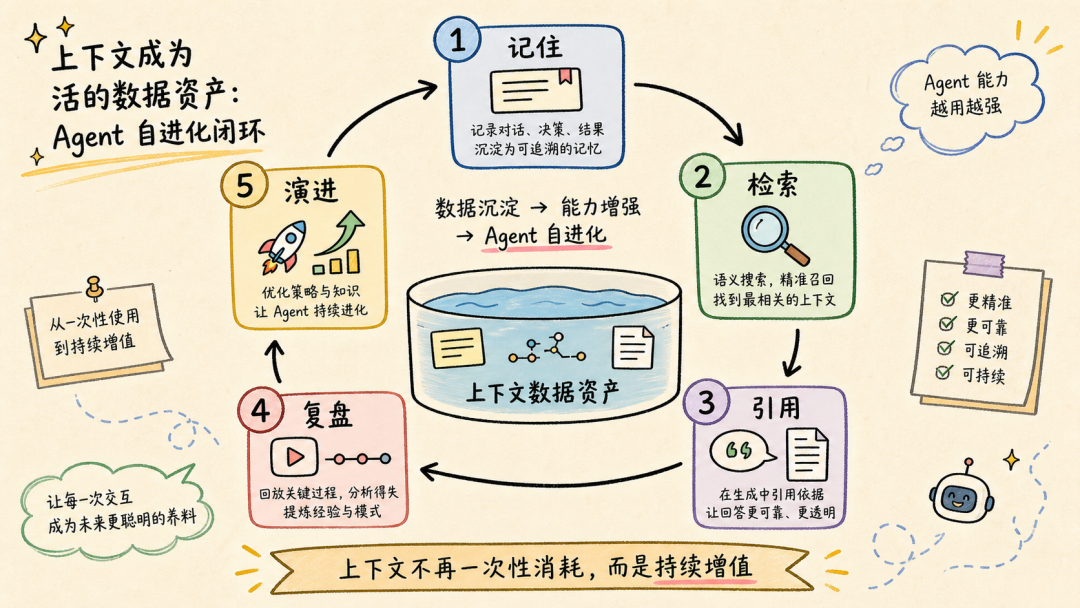
On June 8, the OceanBase and DataFun communities hosted a livestream. Drawing on emerging enterprise use cases and hands-on engineering experience, they discussed how to keep an agent’s context evolving so its capabilities can improve over time through remembering, retrieving, citing, reviewing, and evolving—and so context can become a core data asset.
2. Hangzhou Salon on Agent Production Methodology
On June 24, FastGPT joined OceanBase, Shanghai Sige K2, Sealos, and AskTable at Huanglong International Center in Hangzhou for the salon “Agent Production Methodology: From Technical Construction to Enterprise Deployment.”
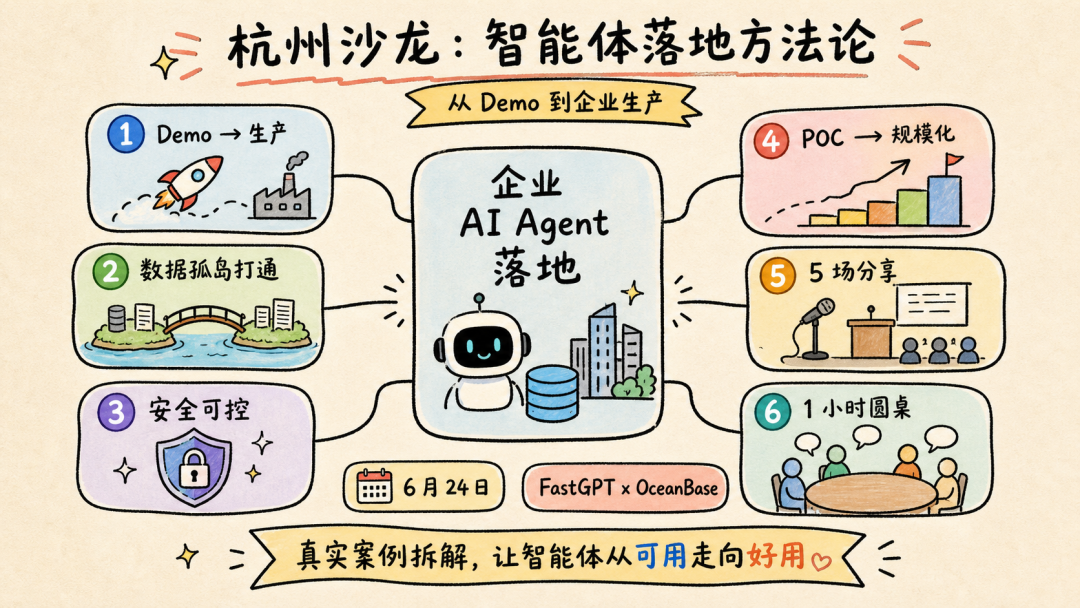
The event focused on the systems-engineering problems that appear after agents leave the demo and enter production: breaking data silos, staying secure and controllable, and moving from PoC to scaled use. Five talks and a one-hour roundtable unpacked real cases from finance, manufacturing, and consumer industries. Recap: From Shanghai to Hangzhou, FastGPT and six communities put agents into real business.
3. From Framework Orchestration to a Data Flywheel: New Ideas for Building Agents in China
Multi-agent applications have moved from experiments into production, but a significant gap remains between a working demo and continuous evolution. Orchestration tools are flourishing while data layers remain fragmented: context is scattered, traces disappear, and execution trajectories become disposable artifacts. Debugging becomes guesswork, optimization depends on luck, and each iteration requires rework.
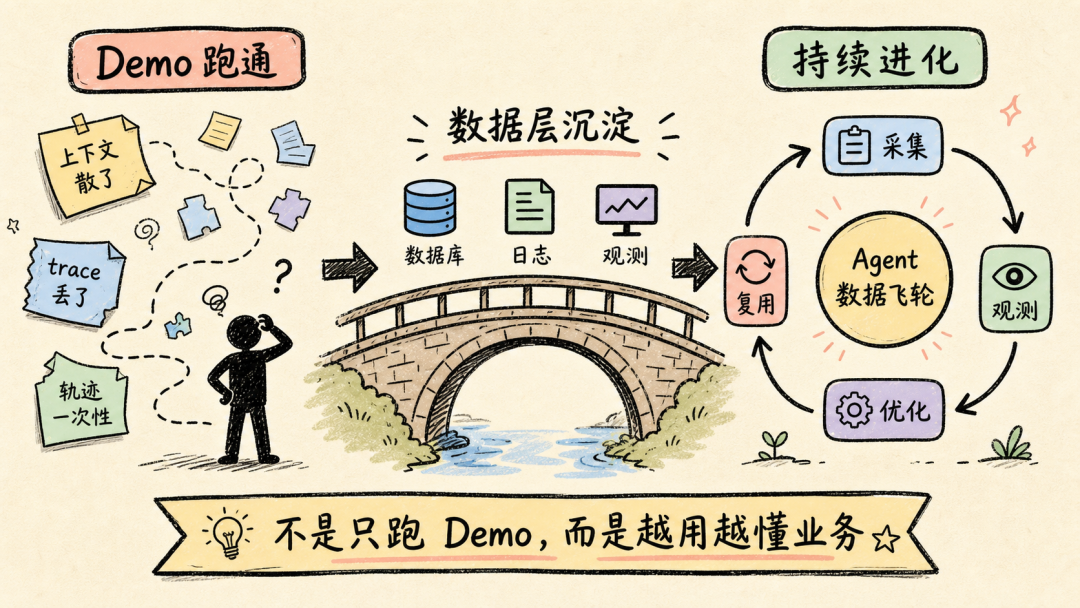
On June 25, OceanBase and CSDN co-hosted a livestream. They invited the technical lead of Tongyi Lab’s AgentScope project and a LangChain community ambassador to discuss the most practical engineering choices for developers in China (watch the replay on the “Lao Ji’s Tech Chat” WeChat video channel).
4. OceanBase Hours Online Launch
On June 29, the OceanBase Hours online launch streamed on multiple platforms. It covered OceanBase’s new explorations in the AI era and announced an AI database built for lakehouse integration.
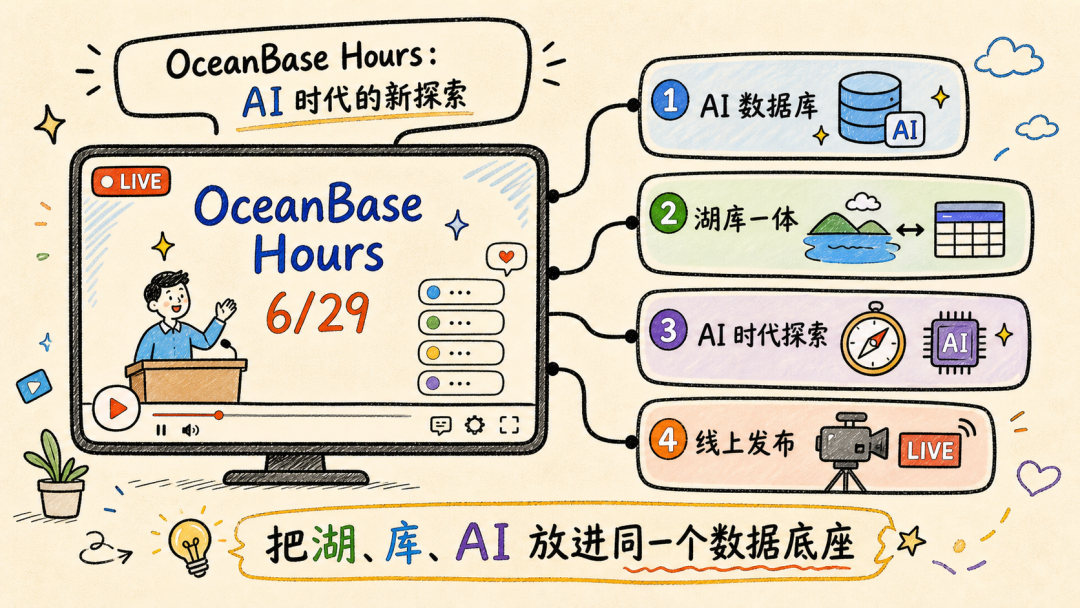
Details: OceanBase lakehouse AI database officially launched.
Community Course Co-Creation Call
The DataWhale × OceanBase community course Easy Data x AI is recruiting co-creators.
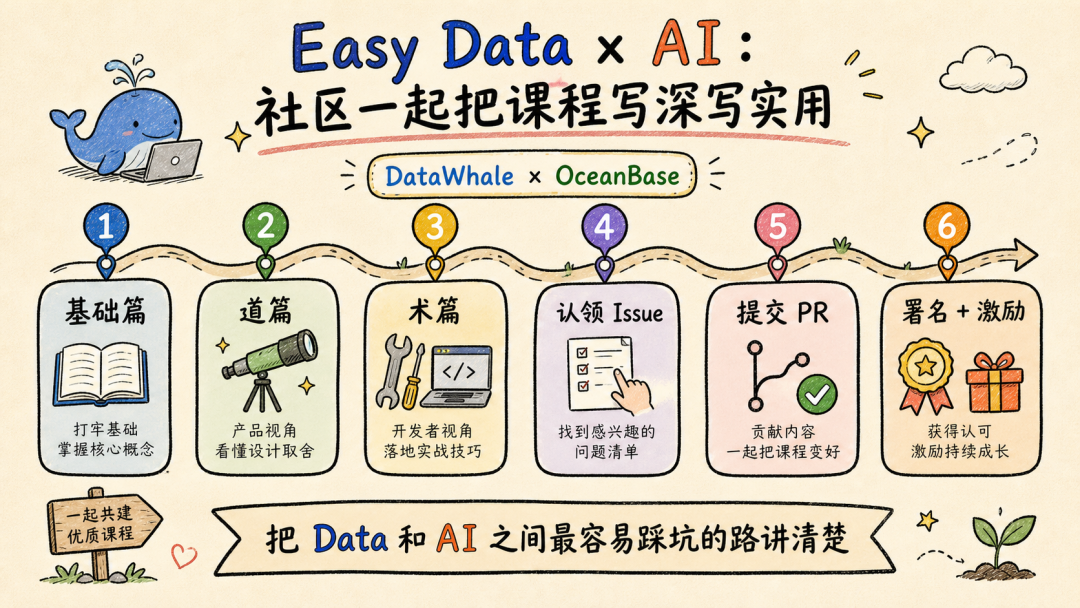
This is not another package for learning large models from scratch. It focuses on the difficult ground between data and AI, where practitioners most often stumble. DataWhale and the OceanBase community are building it together. It already includes a fundamentals track, a product-oriented “Dao” (principles) track, and a developer-oriented “Shu” (practice) track.
Course repo: https://github.com/datawhalechina/easy-data-x-ai
We want the community to help make the course deeper, more accurate, and more practical. Contributing is simple: read the course contributing guide, find an issue you care about, claim it in a comment, and then open a PR. Even correcting a factual error counts. If you independently complete an extension chapter, you will receive formal credit.
We hope every participant both contributes and grows through the process. Contributors whose PRs are merged will receive community merchandise. Details: Help build the data fundamentals course for the agent era: Easy Data x AI introductory course call for contributors.
July Event Preview
In July we will meet you in Guangzhou, Shenzhen, Shanghai, and Suzhou. Watch the community events page to register.
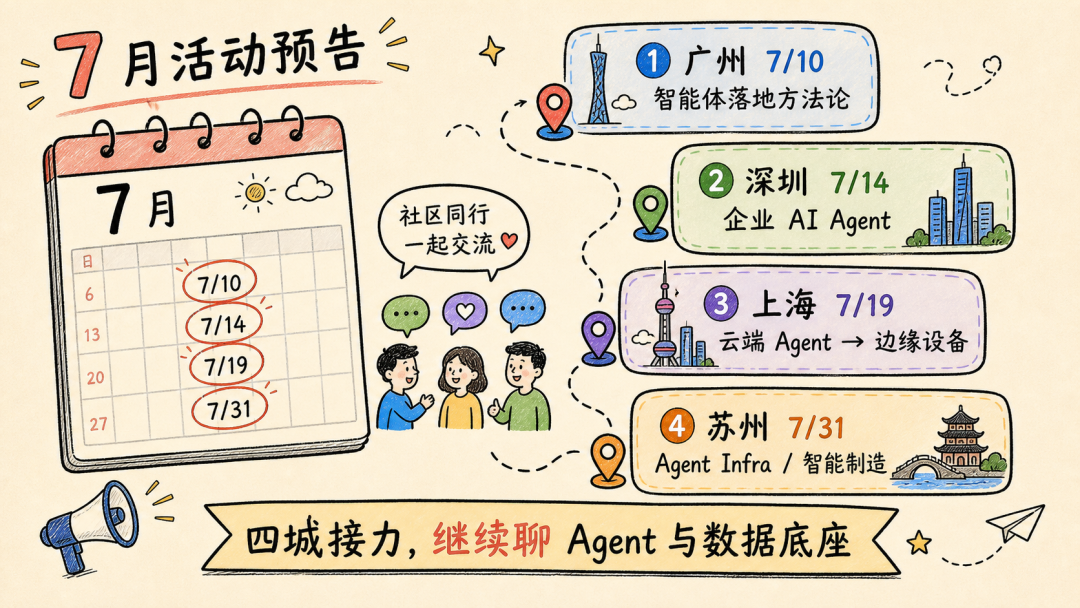
- July 10 in Guangzhou and July 14 in Shenzhen: “Agent Production Methodology: From Technical Construction to Enterprise Deployment.” FastGPT joins OceanBase, Qoder, Sealos, and AskTable for a two-city technology salon on advancing enterprise AI agents from individual productivity tools to organization-wide capabilities. Details: What is the secret to agents that get smarter with use? Guangzhou and Shenzhen in July.
- July 19: From cloud agents to edge devices — making AI remember, run fast, and stay accurate (L141, L1, Expo Park, Pudong New Area, Shanghai).
- July 31: Agent Infra Suzhou — from manufacturing to intelligent manufacturing (Suzhou Industrial Park, High-tech Zone, Suzhou, Jiangsu).
Every month, we hold a community progress briefing. We hope these conversations will make the OceanBase open-source community more transparent and welcoming, improve information sharing, answer questions, and give everyone a voice.
If you have suggestions for the community, please open Issues or PRs on GitHub. You are also welcome to become a Contributor and join the community.
Follow the WeChat official account “Lao Ji’s Tech Chat” for more updates. Extra materials are in that account’s private-message menu.
You are welcome to join the OceanBase community. You can also send the official account a private message naming the product you are interested in—such as OceanBase, seekdb, or PowerMem—to receive related materials.