OceanBase Teams Up with Baidu ERNIE & PaddlePaddle, Qoder, and Multiple Hardware Vendors to Explore Production-Grade Agent Deployment
On April 25, the Meetup titled “Storage and Compute Evolution in the Agent Era: From Fragmented AI Applications to Production-Grade Intelligence Engines”—co-hosted by OceanBase, Baidu ERNIE & PaddlePaddle, and Qoder, with support from smart-hardware companies including Vinci, AAEON, DEEPX, and Shenlei Semiconductor—wrapped up successfully on the 19th floor of Yingfeng Center in Shenzhen’s Nanshan District.
Built around a “pure hands-on, deployment-focused, like-minded” core positioning, the event brought together industry technical experts, frontline developers, enterprise tech leads, and smart-hardware practitioners to dig deep into the key levers for moving AI Agents from lab demo prototypes to enterprise production-grade rollouts at scale—a fitting finale to a high-quality, high-density, hands-on regional tech gathering.
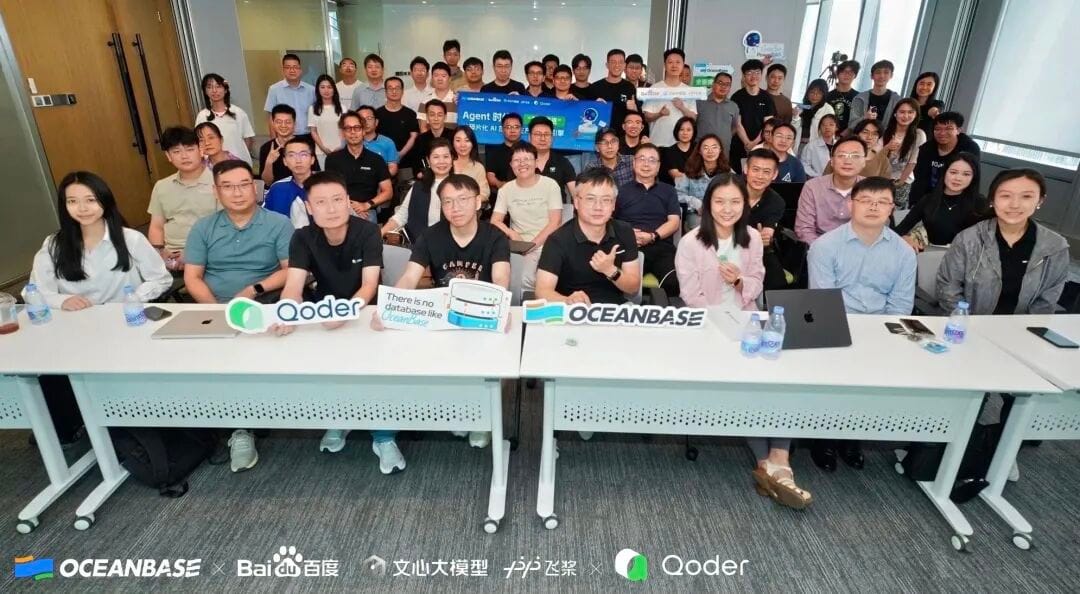
The agenda was solid and packed end to end, covering frontier Silicon Valley AI trend analysis, hands-on breakdowns of enterprise AI rollouts at scale, all-hands AI office collaboration, lightweight digital-assistant building with Baidu PaddlePaddle, OpenClaw software-hardware ecosystem sharing, and a hands-on ClawMaster Workshop—the full chain from start to finish.
The program offered both forward-looking takes on macro industry trends and deep dives into core underlying technology, plus immersive hands-on instruction on site, so every attendee could understand it, learn it, apply it, and take it home—fully closing the last mile between AI theory and frontline business deployment.

The AI Endgame: Competing on Data Foundation Capabilities and Deep Hands-On Experience
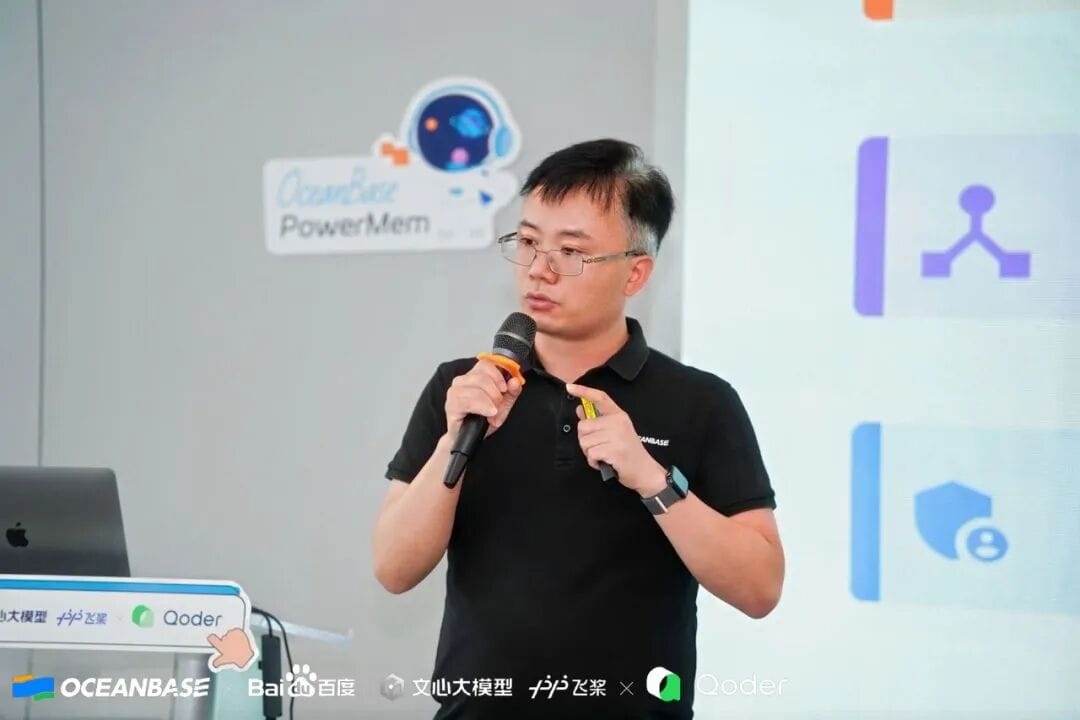
Feng Zhongyan, OceanBase’s Open Source Lead, delivered a comprehensive, in-depth recap of the event’s core themes and the state of the AI industry, drawing on his own firsthand observations from Silicon Valley to pinpoint where the industry stands today and where its technology is heading.
Feng summed it up: Silicon Valley’s AI scene is intensely active right now. Offline events on AI, Agents, frontier software research, and open source ecosystems run constantly there; the atmosphere of technical exchange and cross-industry collaboration is electric, and developers deeply participating in hands-on AI tooling and technical co-creation has become the industry norm.
On the AI industry’s transformation, Feng noted that AI is no longer a pure model race—it has fully entered a new phase of mass-producing digital workers and re-engineering software production. Many frontier startups now rely entirely on AI digital workers for SEO content generation, video production, website operations, and the full range of marketing work, while their R&D pipelines lean on multiple AI coding tools for collaborative development and iterative code review, driving exponential gains in software production efficiency. AI is fundamentally reshaping how the entire software industry produces software; in the future, all software will continuously self-evolve on top of AI, and the deep fusion of algorithms and data will become the core engine of technical iteration.
On the evolution of underlying data systems, Feng pointed out that traditional structured-data management can no longer keep pace with enterprise Agent rollouts at scale—data management is rapidly shifting toward a mesh-like structure, LLM-driven, and self-evolving future.
He stressed that data intelligence develops along three main dimensions: intelligent data management, deep data mining, and a powerful storage system for data storage and search. Storage systems must evolve toward being more atomic, more lightweight, and natively multimodal. OceanBase, with its native unified hybrid-query capability, can handle every type of data in one place.
Feng highlighted OceanBase 4.6.0, released just that April. The release completely re-architects the hybrid-search compute framework, optimizes the storage-engine pushdown for full-text index operators, and rebuilds the index-merge capability. The numbers tell the story: full-text index build speed is up tenfold over previous versions, and performance on high-frequency intelligent retrieval queries is improved—a perfect fit for the complex multimodal retrieval demanded by the AI era.

A Multimodal Foundation Forged in Industry Practice: AI Memory Engineering Powers Enterprise AI at Scale
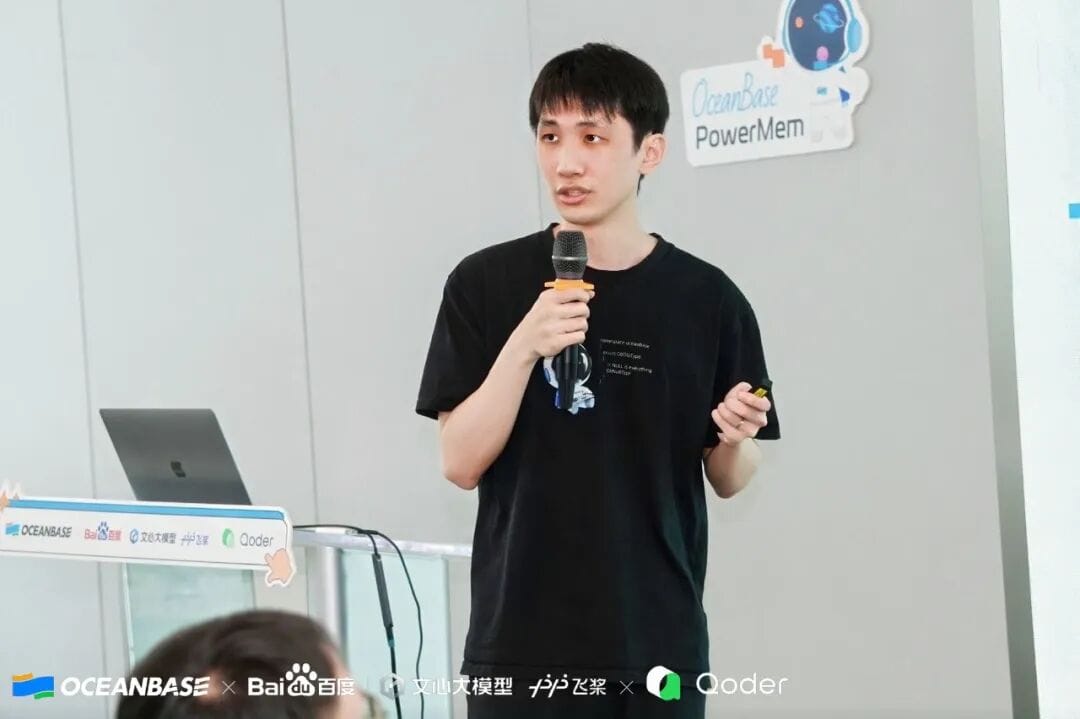
OceanBase technical expert Zheng Xiaofeng delivered a closing technical wrap-up grounded in frontline AI deployment experience across the industry. He called out the prevailing tendency to over-index on models while neglecting the foundation, and to favor demos over deployment, stressing that an enterprise’s core competitiveness in AI at scale lies not in stacking up LLM capabilities but in the solidity of its multimodal data foundation and the rigor of its AI engineering.
For the pain points AI Agents commonly face today—messy context, declining accuracy, and high token costs—Zheng highlighted OceanBase PowerMem, an enterprise-grade intelligent memory management solution. Modeled on the scientific forgetting curve, it manages AI memory in a fine-grained, layered short/medium/long-term scheme. Measured results show that, compared with the traditional full-context approach, AI Q&A accuracy improves by 48%, P95 latency drops by 91%, and token consumption is cut by 97%, while also supporting cross-Agent memory sharing, dual-write data backup, and automatic failover.
Zheng concluded that the long-term logic of the AI industry will inevitably circle back to an integrated foundation, hybrid retrieval, and fine-grained memory.

From Assistant Tool to Dedicated Intelligent Colleague: Lightweight, Secure AI Reshapes the All-Hands Workflow
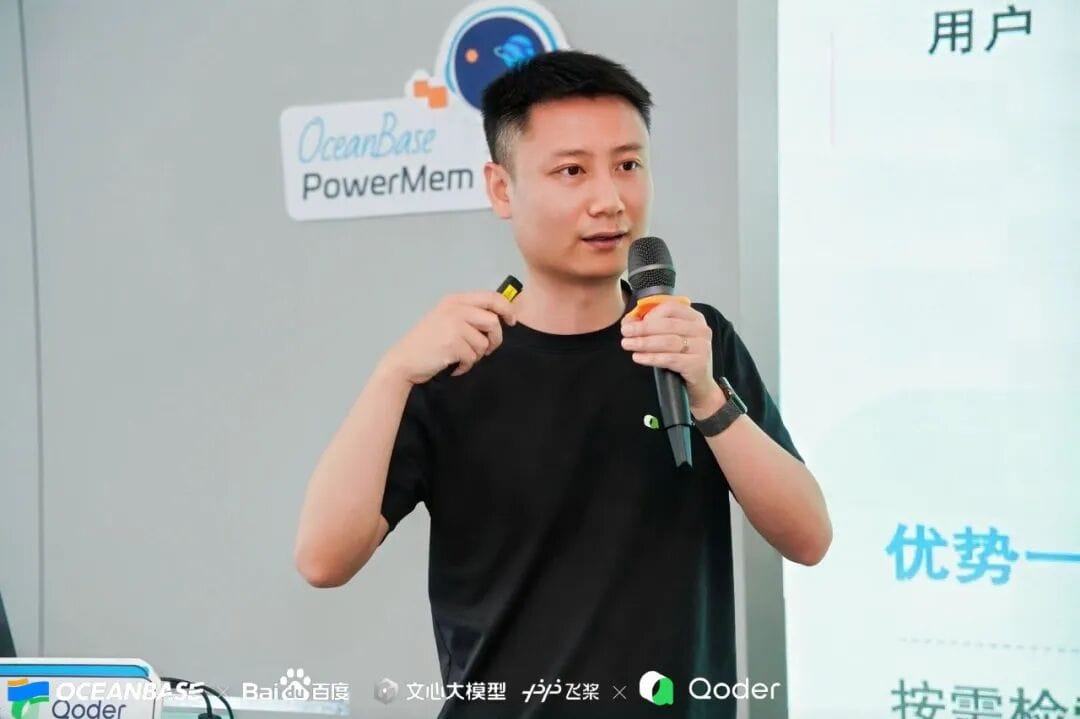
Drawing on the growing adoption of AI in the workplace and the practical pain points of enterprise digital transformation, Qoder senior technical expert Zhou Wen argued that the industry urgently needs an out-of-the-box, secure, controllable, lightweight AI work solution that fits every role. QoderWork’s core goal is to elevate AI from a traditional, passive execution tool into an enterprise-grade dedicated intelligent colleague capable of autonomous planning, automatic execution, and closed-loop feedback.
Zhou revealed that QoderWork has partnered with OceanBase to build out PowerMem’s long-term memory capability, leveraging a local-cloud isomorphic architecture to fit both personal and enterprise scenarios, and combining hybrid retrieval, intelligent memory extraction, and dynamic forgetting-based layered management.

Securing the First Mile of Enterprise Intelligence: OCR + a Multimodal Foundation Unlock Unstructured Knowledge Assets
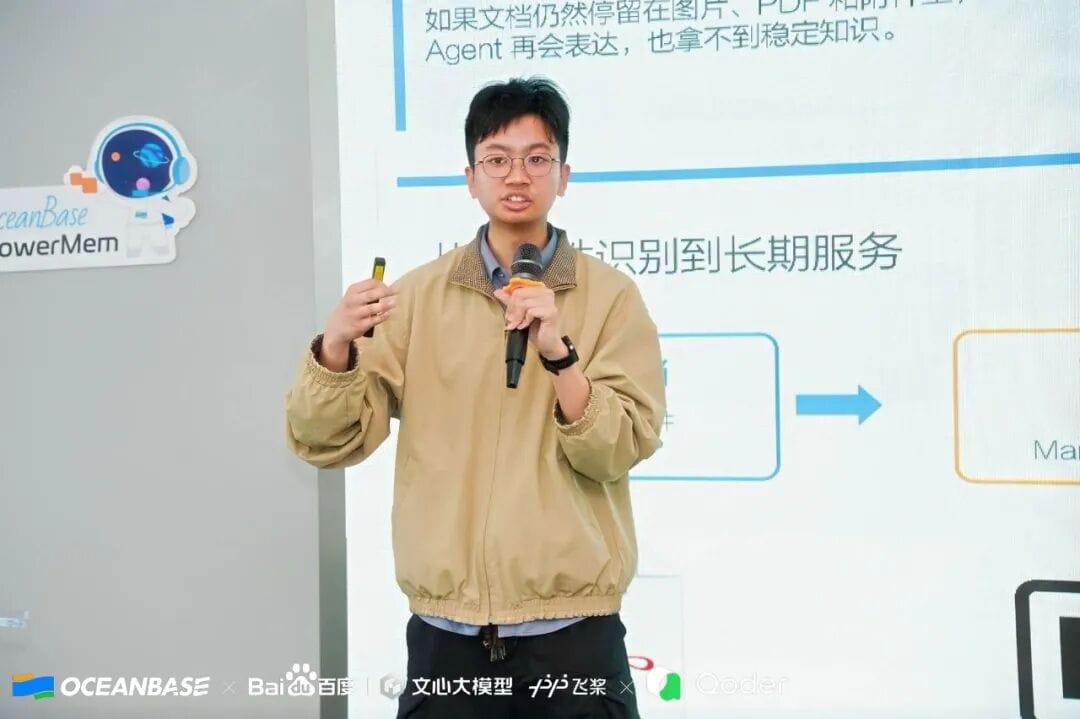
Yang Youzhi, product operations manager at Baidu PaddlePaddle’s Galaxy Community, bluntly observed that the AI industry is currently overheated with hype. The core prerequisite for scaling enterprise AI, he argued, is to close the gap in unstructured-data governance, build a solid foundation for turning documents into assets, and secure the first mile of intelligent transformation.
The new PaddleOCR 3.5 and the PaddleOCR-VL-1.5 model deliver a leap in capability: AI inference models now run natively in the browser, with no backend code or complex interface deployment required, and Word, Excel, and PPT files convert directly to Markdown. PaddlePaddle handles intelligent parsing of unstructured data while OceanBase ingests multimodal text and embedding vectors into a unified store, solving in one place the pain points of scattered data, messy formats, inefficient retrieval, and complex operations.

Lightning Talks Break Down the Software-Hardware Barrier: Multiple Vendors Join Forces to Chart a New Path
Technical leads from four software-hardware ecosystem companies—Shenlei Semiconductor, AAEON, Vinci (Boseng Technology), and DEEPX—took the stage together for lightning talks, focused on breaking down the silos between software and hardware R&D, closing the full edge-cloud collaboration loop, and reinforcing the hardware foundation for OpenClaw’s industry deployment.
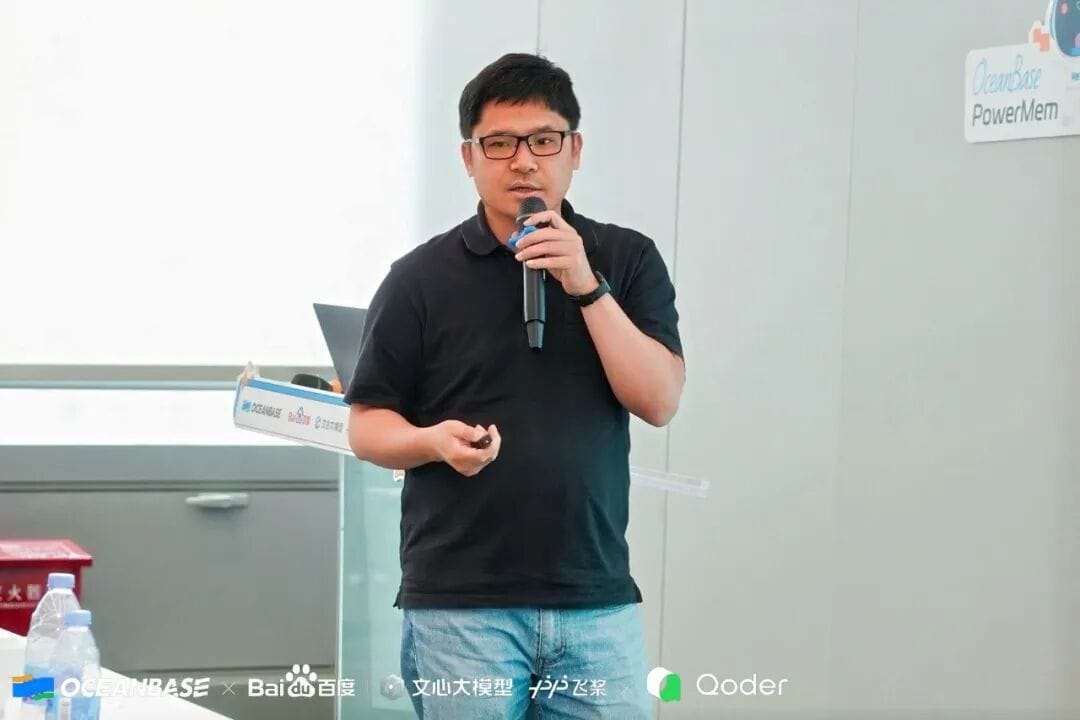
Nong Changlin, edge-computing project lead at Shenlei Semiconductor: The Shenlei VS680 Lobster Box turns edge hardware into a dedicated local AI butler—users only need a one-time LLM key setup, after which it runs stably around the clock.
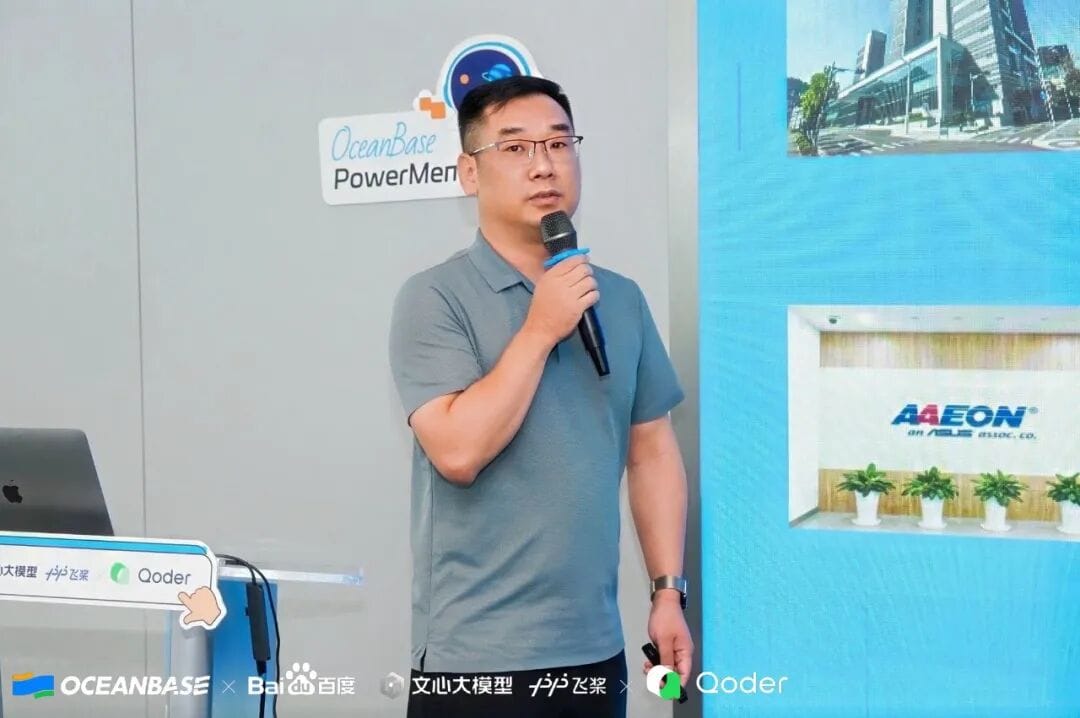
Zhang Xubing, GM of AAEON’s South China region: Industrial-grade AI compute hardware is deeply integrated with the OpenClaw ecosystem, and the related AI workstation hardware shipped at the scale of tens of thousands of units right upon launch.
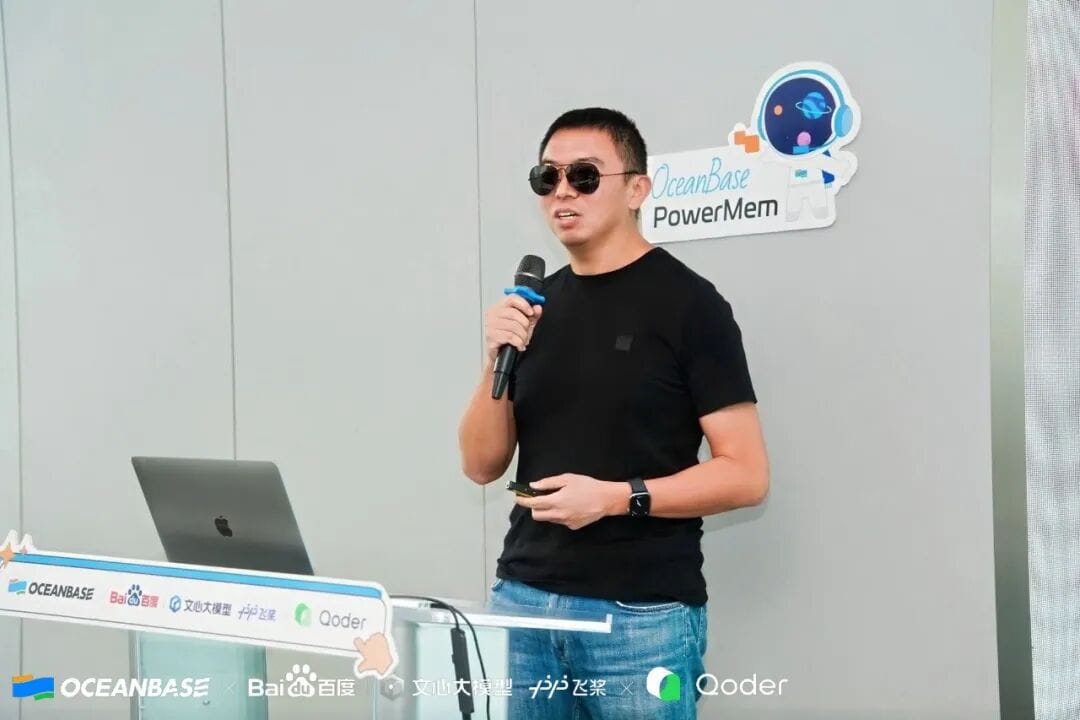
Liu Li, founder of the Vinci brand: A lightweight hardware deployment solution in the tens-of-thousands price range replaces costly compute clusters, decisively solving the problems small and mid-sized enterprises face with high token costs, heavy operational overhead, and low retention.
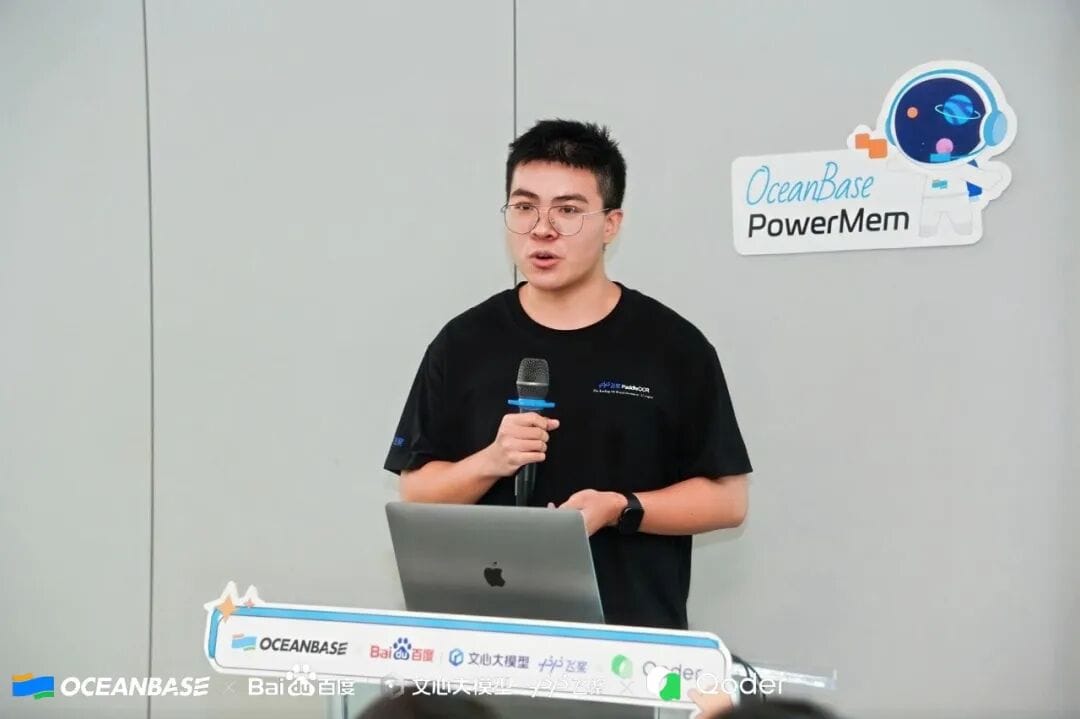
Zhou Jiajie, senior engineer at DEEPX: Leveraging the hardware acceleration of DEEPX’s in-house AI NPU chips, high-frequency essential tasks such as document parsing, image recognition, and OCR inference are all pushed down to run locally at the edge.
The four ecosystem leads jointly concluded that the endgame of AI Agent deployment at scale will inevitably be software frameworks enabling, a data foundation carrying the load, hardware compute as the backstop, and edge-cloud collaboration tying it all together.

A Hands-On Workshop: Turning Theory into Ready-to-Use Results You Take Home
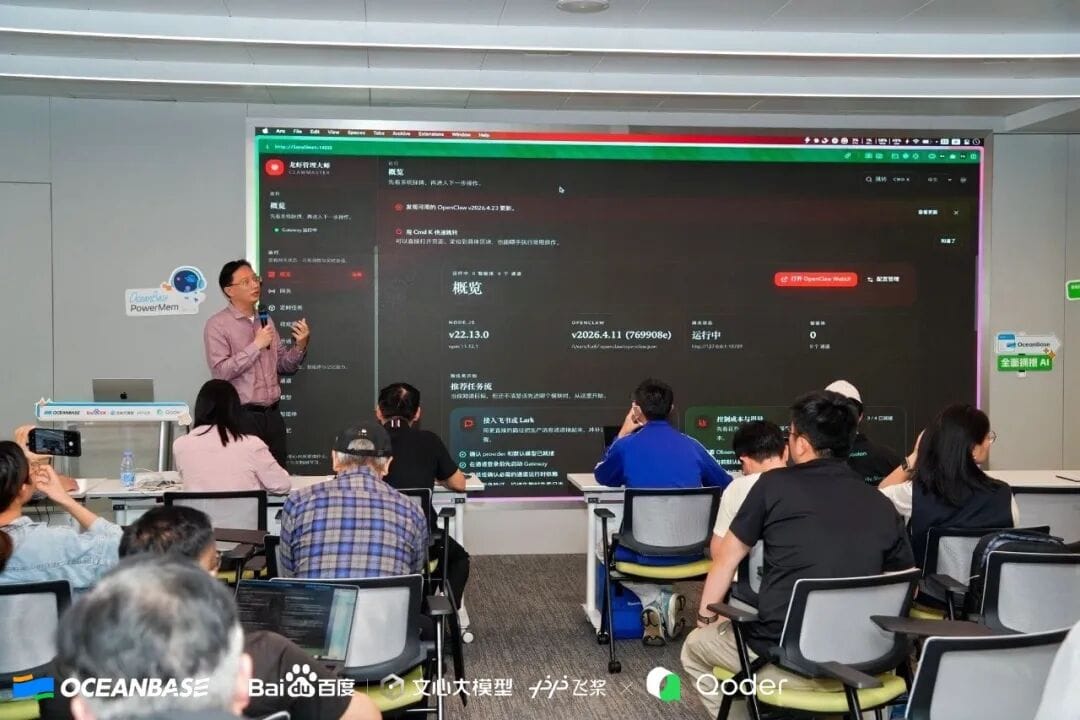
Led on site by LangChain & OceanBase Ambassador Zhang Haili, the hands-on workshop walked every attending developer through the full “Tame Your Lobster with ClawMaster” experience step by step. Even complete beginners could keep pace with the instructor and work through OpenClaw’s end-to-end deployment, debugging, and tuning, putting what they learned to use right away.
Try these links for an early taste:
- ClawMaster: https://github.com/openmaster-ai/clawmaster
- Workshop: https://github.com/openmaster-ai/clawmaster-workshop
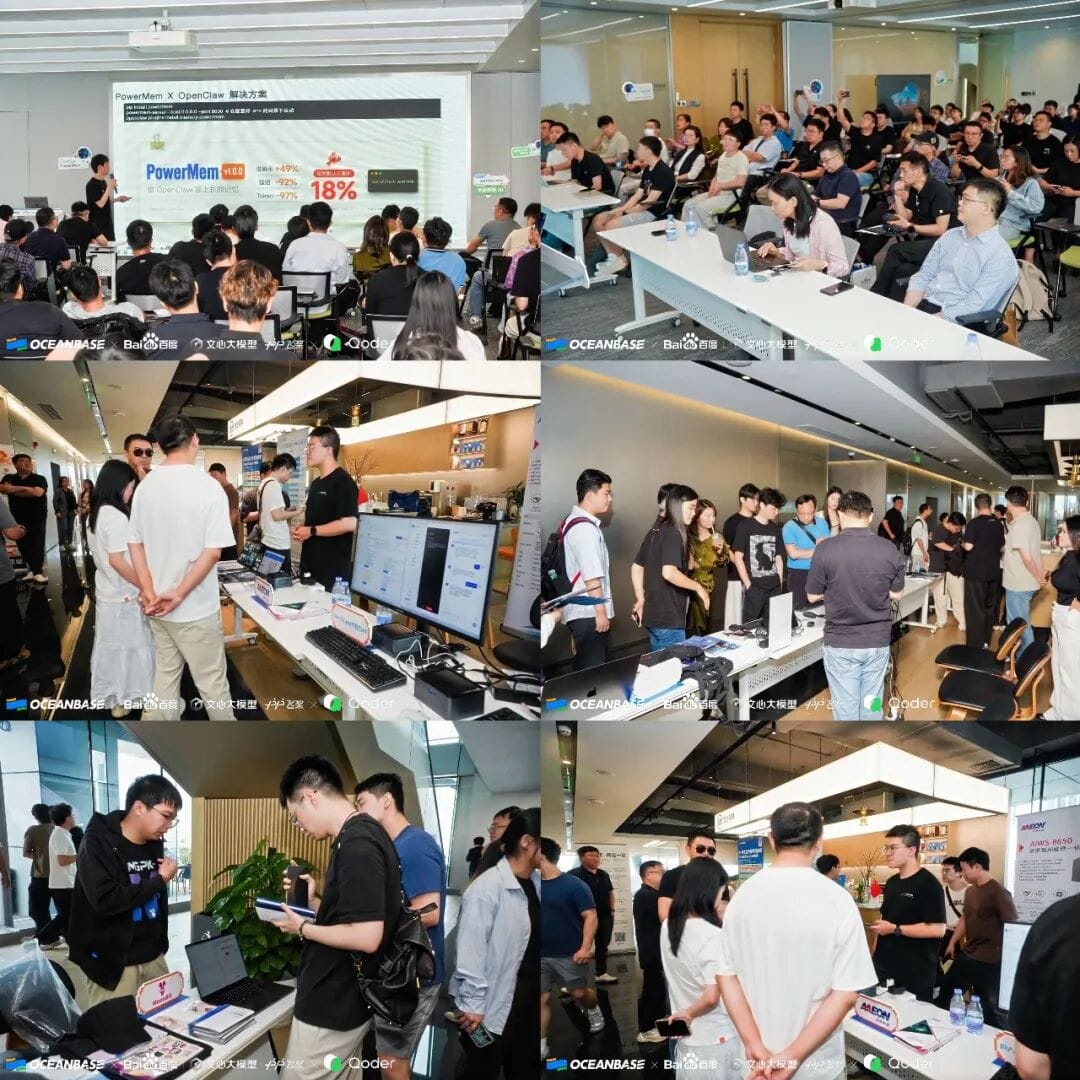
This Shenzhen Agent Storage-Compute Evolution event came to a successful close, syncing frontier Silicon Valley trends with hands-on enterprise deployment methodology and making clear that an integrated storage-compute data foundation is the cornerstone of production-grade AI Agent deployment at scale.
Going forward, OceanBase will continue to partner with its ecosystem to deepen innovation at the intersection of AI and data storage, keep hosting hands-on offline tech events, and help practitioners deepen their craft, master deployment, and connect with resources—jointly driving a thriving production-grade intelligence ecosystem in the Agent era.
Event Preview | Shanghai Session Coming Soon
The lightning-talk sign-up channel is now open—technical peers are welcome to submit topics. Suggested directions include the deep fusion of AI Agents and data, context engineering practices, OpenClaw ecosystem applications, smart-hardware collaboration, and related themes.
How to sign up: leave a message in the official account’s backend with your topic and contact information.