Born for AI: Efficiently Build Your Agent and AI System Architecture with OceanBase seekdb
🌟 Tip: The seekdb mentioned in this article is OceanBase’s open source AI-native database. You’re welcome to try it out at https://github.com/oceanbase/seekdb—we believe it can bring a simpler, more efficient data management approach to your AI application development!
On November 18, OceanBase open sourced its first AI-native database, seekdb (for details, see https://www.oceanbase.ai/ ). It focuses on providing efficient hybrid search capabilities for AI applications, supporting unified storage and retrieval of vector, full-text, and multimodal data.
seekdb inherits OceanBase’s high-performance advantages and full MySQL compatibility, yet is more lightweight—closer to individual developers and small-to-medium enterprises, and more suited to AI data processing scenarios:
- RAG and knowledge retrieval, such as customer support, personal knowledge, and enterprise quality assurance.
- AI Agents, such as personal assistants, agent platforms, vertical agents, and enterprise automation.
- On-device and edge AI applications, such as in-vehicle systems, AI education, companion robots, and medical devices.
- AI-assisted programming, or coding and development, such as IDE plugins, design-to-web, local IDEs, and Web IDEs.
- Semantic search engines, such as product search, text-to-image, and image-to-product.
- Enterprise application intelligence, such as document intelligence, business insights, and financial systems.
We sincerely invite AI application developers, agent developers, enterprise AI R&D and operations engineers, and database enthusiasts to try it out and write up their results and impressions. If you’d rather not write a full piece, you’re also welcome to share scattered hands-on experiences, suggestions, or gripes in the “seekdb” section of the OceanBase community Q&A page (https://ask.oceanbase.com/c/seekdb).
01 Writing Directions
Direction 1: Deploy and Use OceanBase seekdb
- Experience seekdb: hybrid search, AI function services, hybrid vector indexing, and try out the Vibe coding paradigm with Cursor Agent + OceanBase MCP.
- Use seekdb and describe how you used it, or optimize seekdb and share your optimization approach.
Quick deployment: https://www.oceanbase.ai/docs/deploy-seekdb-testing-environment
Direction 2: Build AI Applications/Agents/Systems and Frameworks
Any system or application that truly runs depends on underlying infrastructure. As the data processing and analysis engine, OceanBase seekdb sits beneath the upper-layer AI applications. The intermediate layers may include knowledge bases, memory systems, programming frameworks, and AI platform development tools.
You can:
- Develop AI applications, agents, systems, or anything else based on seekdb and the 30-plus AI frameworks compatible with it—such as Dify, Coze, LangChain, and LlamaIndex—as well as the MCP protocol for large models.
- Develop AI applications, agents, systems, or anything else based on seekdb and PowerMem—and feel free to hack on PowerMem’s internals.
- Build AI applications with persistent memory (such as intelligent assistants and personalized recommendation systems).
- Develop multi-agent collaboration systems that enable memory sharing and isolation between agents.
- Create intelligent memory systems supporting the storage and retrieval of multimodal content (text, images, audio).
- ……
- Extend new AI applications based on seekdb and PowerRAG—and feel free to hack on PowerRAG’s internals.
- Build enterprise knowledge base systems supporting intelligent retrieval over large-scale documents.
- Develop multimodal RAG applications that handle mixed content such as text, images, and tables.
- Implement enterprise-grade access control and security mechanisms.
- Optimize retrieval strategies to improve the accuracy and response speed of the RAG system.
- ……
PowerMem and PowerRAG are products open sourced at the same time as OceanBase seekdb.
- PowerMem is an intelligent memory SDK built specifically for AI applications, helping developers quickly build AI application systems with long-term memory. In testing, it improves search accuracy and system response speed while reducing Token usage.
- RAG is the mainstream architecture for AI applications today. But building a production-grade RAG system requires document parsing, chunking, and vectorization; multimodal content processing; retrieval strategy optimization; and enterprise-grade security and permissions. PowerRAG integrates all these capabilities, sparing developers from the tedious work of combining multiple tools and tuning them repeatedly.
Come on—unleash your creativity and bring these to life with seekdb! The community looks forward to the debut of your “product.”
Related Resources and Tutorials:
Tutorial for building AI applications with seekdb: https://www.oceanbase.ai/docs/build-ai-apps
Tutorial for building RAG with seekdb: https://open.oceanbase.com/blog/23831215424
seekdb repository: https://github.com/oceanbase/seekdb
PowerMem repository: https://github.com/oceanbase/powermem
PowerRAG repository: https://github.com/oceanbase/powerrag
02 How to Participate
Step 1: Choose a participation direction (just pick one of the two) and deploy OceanBase seekdb.
Step 2: Write about your hands-on experience, key takeaways, and optimization suggestions. Topics may include, but are not limited to:
- Suggestions for improving UI interaction, operational flow, and visualization.
- Suggestions for core feature extensions, new feature innovations, and improvements to existing features.
- Architecture discussions, along with proposals for toolchain integration and third-party service connections.
- Development experience and suggestions.
- The background and conception of your application development, the development process and challenges, application demo results, and so on.
- Other suggestions.
Step 3: Publish your article and select the tag: Event—AI-Native seekdb.
- You can publish directly on the OceanBase community blog (URL: https://open.oceanbase.com/blog).
- Or you can publish first on your own content channel, then sync it to the OceanBase community blog.
Step 4: Wait for the public results announcement. The results will be announced simultaneously on the “Lao Ji’s Tech Talk” WeChat account, the community blog, and the Q&A page.
Step 5: Contact the OB community assistant (WeChat: OBCE666) to claim your prize. The community will dispatch the prize within 7 business days of receiving your mailing address.
03 Content Requirements
- Articles must be no fewer than 800 words (word count excludes code), well illustrated, and neatly formatted.
- Articles must be original with a title of your own choosing. When publishing, select the “AI-Native seekdb” tag. No advertising, content spinning, plagiarism, traffic gaming, or AI-generated content is allowed; once discovered, the article will be disqualified from the contest.
You may refer to the community writing guidelines: https://open.oceanbase.com/blog/272001526
Sample article for reference: https://open.oceanbase.com/blog/20970309232
04 Schedule
Submissions: December 1 – January 20
Expert judging: January 21 – January 26
Results announced: January 27
Prizes dispatched: January 27 – January 31
05 Judging Rules
- Initial review: After submission, the OceanBase review panel will conduct an initial review. Articles that pass will proceed to judging; for those that don’t, the panel will offer revision suggestions, and you may resubmit after revising.
- Judging: Articles will be scored jointly by OceanBase technical experts, with the final score being the average. The top 15 will be shortlisted, and from the shortlist we will select the other awards based on a combination of scores, reads, and likes.
- Scoring dimensions (100 points total):
- Technical (40): The article includes hands-on experience and offers principle analysis and technical depth.
- Content (40): The content is instructive, practical, and includes reasonable suggestions or questions.
- Structure (10): The article is clear and comprehensive, with a complete structure and well-organized logic.
- Formatting (10): The article is neatly formatted, well illustrated, clearly divided into paragraphs, with key points highlighted.
06 Contest Prizes
Evangelist Award (1 winner): A Huawei Watch GT 6 Pro worth 2,500 RMB.
Craftsmanship Award (1 winner): An open source programming robot worth around 1,000 RMB.
Pioneer Award (3 winners): A carry-on suitcase worth 500 RMB.
Encouragement Award (10 winners): An OceanBase community gift pack worth 200 RMB, including 50 community points, a nylon shoulder bag, a physical book on source code analysis, and a neck massager.
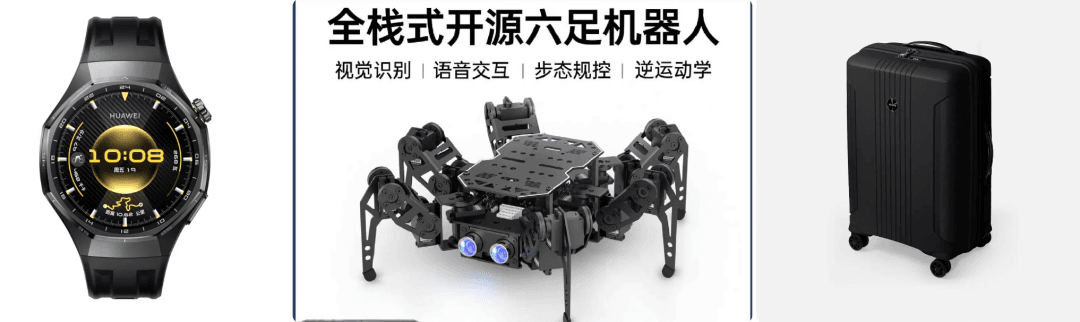
Please note: after the results are announced, contact the OB community assistant (WeChat: OBCE666) to claim your prize. If you have not contacted the community by January 30, you will be deemed to have voluntarily forfeited your prize.
07 Q&A
Q: Is there a limit on the number of submissions?
A: Participants may submit multiple times.
Q: Can I win prizes multiple times?
A: If a single person wins with multiple articles, the honoraria and prizes cannot be stacked. We recommend consolidating your experience into a single article and polishing its depth, which makes it easier to win a major prize.
Q: Can I delete an article after it’s published?
A: Articles that have been published and have won cannot be deleted.
Q: Can I enter with a previously published article?
A: Yes. First publication on the OceanBase community blog is not required; you only need to sync the article to the community blog within the contest’s valid period and select the designated contest tag. If plagiarism is discovered, you will be disqualified.
Q: What should I do if I find someone plagiarizing or spinning content?
A: You’re welcome to contact the official operations staff to report it.